
The end of the world won’t happen tomorrow morning, but on the scale of the Universe, it’s basically the day after. According to simulations by NASA and Japan’s Toho University, life on Earth is doomed, not because of humans, for once, but because of… the Sun itself.
As it ages, our “friendly glowing neighbor” will keep heating up. The result: it will eventually drain the atmosphere of all its CO₂, the same CO₂ we complain about today, but which is essential for photosynthesis. No CO₂ means no plants. No plants means no oxygen. No oxygen… well, you get the idea. Earth’s atmosphere will turn into a toxic methane cocktail, guaranteed unbreathable.

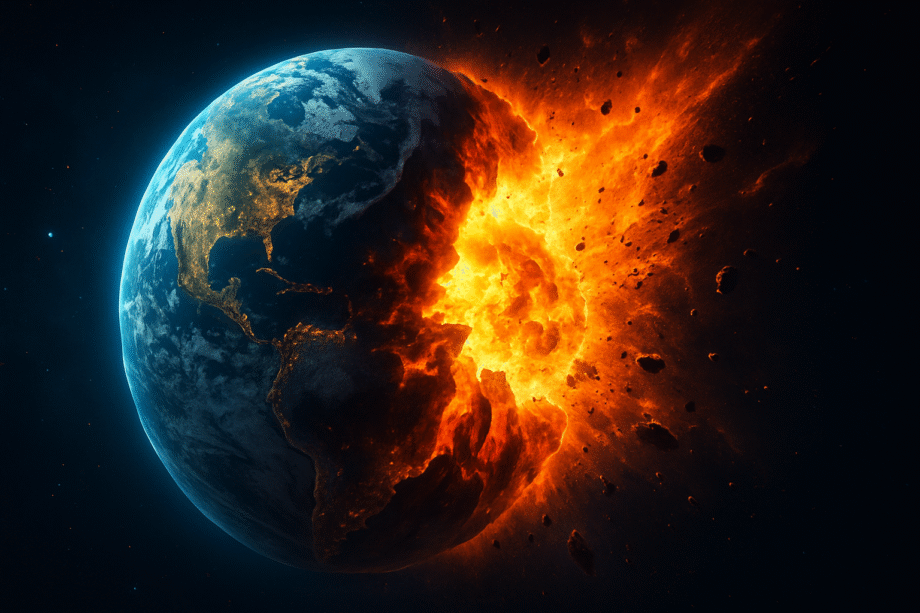
With oxygen gone and the ozone layer collapsing, the planet will become a giant solar oven: extreme heat, evaporating oceans, dying vegetation. In the end, only a few hardcore, anaerobic microorganisms will still be around to say “hello.” For us? Curtain closed.
Planetary Barbecue
Simulations predict that all life on Earth will be gone in roughly one billion years. Huge for us; a cosmic blink for the Universe.
As for the Sun, it will continue toward its fate: collapsing into a white dwarf in about 6.5 billion years. Lovely.
And humans in all this? No need to panic — we definitely won’t be here to attend the final planetary barbecue. But scientists warn that the first serious signs — dropping oxygen levels, rising solar storms — could begin in as little as 10,000 years. So yes, Earth will remain habitable for a while… just not forever.
Which is why humanity is already thinking ahead: artificial habitats, domed cities, colonizing Mars. We’ve got some time, but maybe not enough to waste it.